Project Overview
Improved methods for predicting and reducing noise for civil supersonic aircraft would be highly valued by the research and technology development community engaged in civil supersonic aircraft development. In addition to aircraft and engine companies, organizations such as the National Aeronautics and Space Administration (NASA), FAA, and the U.S. Department of Defense (DoD), and the research and technology community would benefit from improved methods and tools. Supersonic jet noise tools with predictive capabilities can be used to design improved noise mitigation systems and to provide estimates of noise for certification studies.
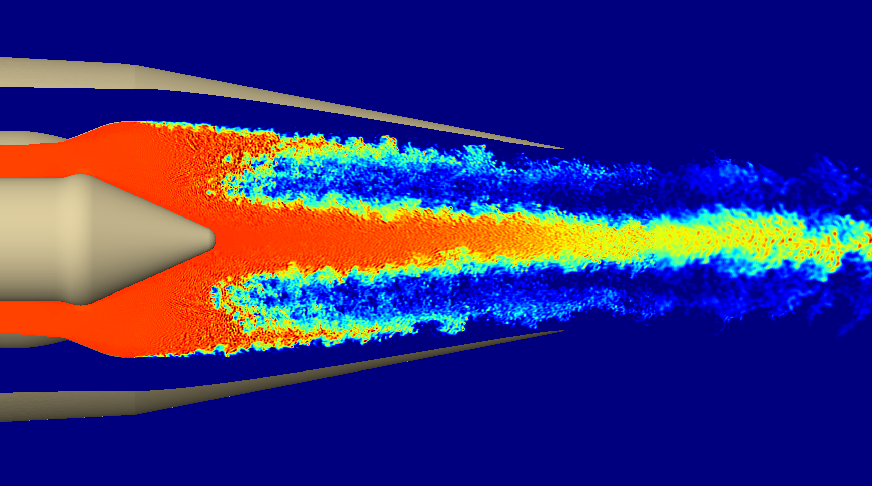
This project involves the coordinated development of both low- and high-fidelity approaches for jet noise predictions for civil supersonic aircraft. High-fidelity Large-Eddy Simulations (LES) of the jet exhaust flow and noise are developed for a carefully selected subset of configurations and operating points, tested experimentally at the Georgia Institute of Technology (Georgia Tech) and at NASA Glenn Research Center. In parallel, Reynolds-averaged Navier–Stokes (RANS) computations of a broader range of configurations and operating conditions relevant for civil supersonic aircraft are performed and used to develop improved jet noise source models and more accurate far-field noise propagation kernels. Our goal is to understand the predictive quality of RANS-based noise prediction approaches with improved source and/or propagation models so that designers can better capture tradeoffs typical in the development of full civil supersonic aircraft configurations.
Project Team
- Dr. Sanjiva K. Lele (P.I.; Department of Aeronautics and Astronautics)
- Dr. Juan J. Alonso (P.I.; Department of Aeronautics and Astronautics)
- Dr. Gao Jun Wu (former PhD student; Department of Aeronautics and Astronautics)
- Dr. Tejal Shanbhag (former PhD student; Department of Aeronautics and Astronautics)
- Dr. Kristen Matsuno (former PhD student; Department of Mechanical Engineering)
- Olivia Martin (PhD student; Department of Mechanical Engineering)
Research Goals
- Develop and validate high-fidelity LES jet noise predictions for single-stream baseline geometry configurations
- Develop and validation high-fidelity LES jet noise predictions for more practical dual-stream nozzle configurations with noise mitigation concepts (e.g. internal lobed mixers + plugs)
- Understand sensitivities of LES noise predictions to modeling choices, nozzle configuration, and operating conditions
- Develop and validate RANS-based jet noise predictions for baseline configurations and noise mitigation concepts
Nozzle Configurations
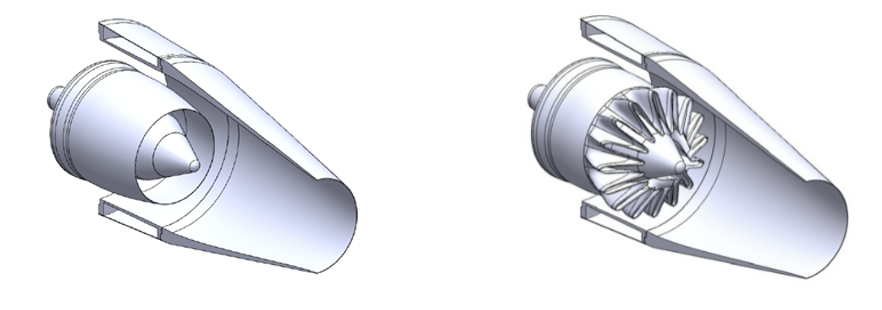
NASA Plug20 nozzles
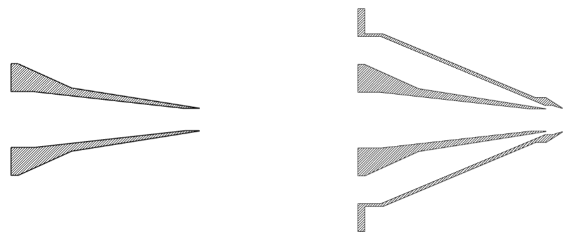
Georgia Tech nozzles
Publications
- Wu, G. J. (2024). Towards quieter supersonic flight: a computational aeroacoustic study of high-speed jets (Ch.4) [Doctoral dissertation, Stanford University]. Stanford University.
- Shanbhag, T. K. (2024). RANS-based methods for the prediction and reduction of jet noise [Doctoral dissertation, Stanford University], Stanford University.
- Shanbhag, T. K., Zhou, B. Y., Ilario, C. R. S., & Alonso, J. J. (2024, January 8-12). An AD framework for jet noise minimization using geometrical acoustics [Conference paper]. AIAA SCITECH 2024 Forum, Orlando, Florida.
- Wu, G. J., Martin, O. G., & Lele, S. K. (2024, June 4-7). Computational aeroacoustic study of coannular nozzles with internal mixing geometries at high transonic Mach numbers [Conference paper]. 30th AIAA/CEAS Aeroacoustics Conference, Rome, Italy.
- Shanbhag, T. K., Zhou, B. Y., Ilario, C. R. S., & Alonso, J. J. (2024, June 4-7). Adjoint-based jet noise minimization using geometrical aeroacoustics [Conference paper]. 30th AIAA/CEAS Aeroacoustics Conference, Rome Italy.
- Martin, O. G., Wu, G. J., & Lele, S. K. (2024, July 29-August 2). Noise predictions of a dual-stream jet with forced internal mixing [Conference paper]. AIAA Aviation Forum and ASCEND 2024, Las Vegas, Nevada.